
Understanding Fetal Heartbeat Monitoring: Intermittent vs Continuous Monitoring in Labor

Photo By Shanika Granville
Hearing your baby’s heartbeat for the first time can be a profound moment.
That tiny, rhythmic sound represents a life that may still be beating on this planet ninety years from now. While most parents aren’t thinking quite that far ahead, many describe that first heartbeat as the moment pregnancy begins to feel real.
Using a handheld Doppler, a baby’s heartbeat can often be detected as early as 9–10 weeks of pregnancy during routine prenatal care. Some people giggle when they hear it for the first time. Others cry. Some sit quietly, stunned. There is no “right” reaction — just a deeply human one.
For many families, hearing the heartbeat is reassuring, especially before fetal movement can be felt. We often recommend recording it to listen to later, helping deepen the connection with your growing baby. Siblings love being part of this moment too — they often help apply the Doppler gel (affectionately known around Alma as “belly jelly”).
How Fetal Heartbeat Monitoring Works
Fetal heartbeat monitoring is one way providers assess how a baby is tolerating pregnancy and labor. There are two primary approaches:
Continuous Fetal Monitoring (CFM)
Intermittent Fetal Monitoring (also called intermittent auscultation)
At Alma Midwifery, we use intermittent fetal monitoring for low-risk births, including during active labor.
Here’s why.
Continuous Fetal Monitoring: What It Looks Like in Hospitals
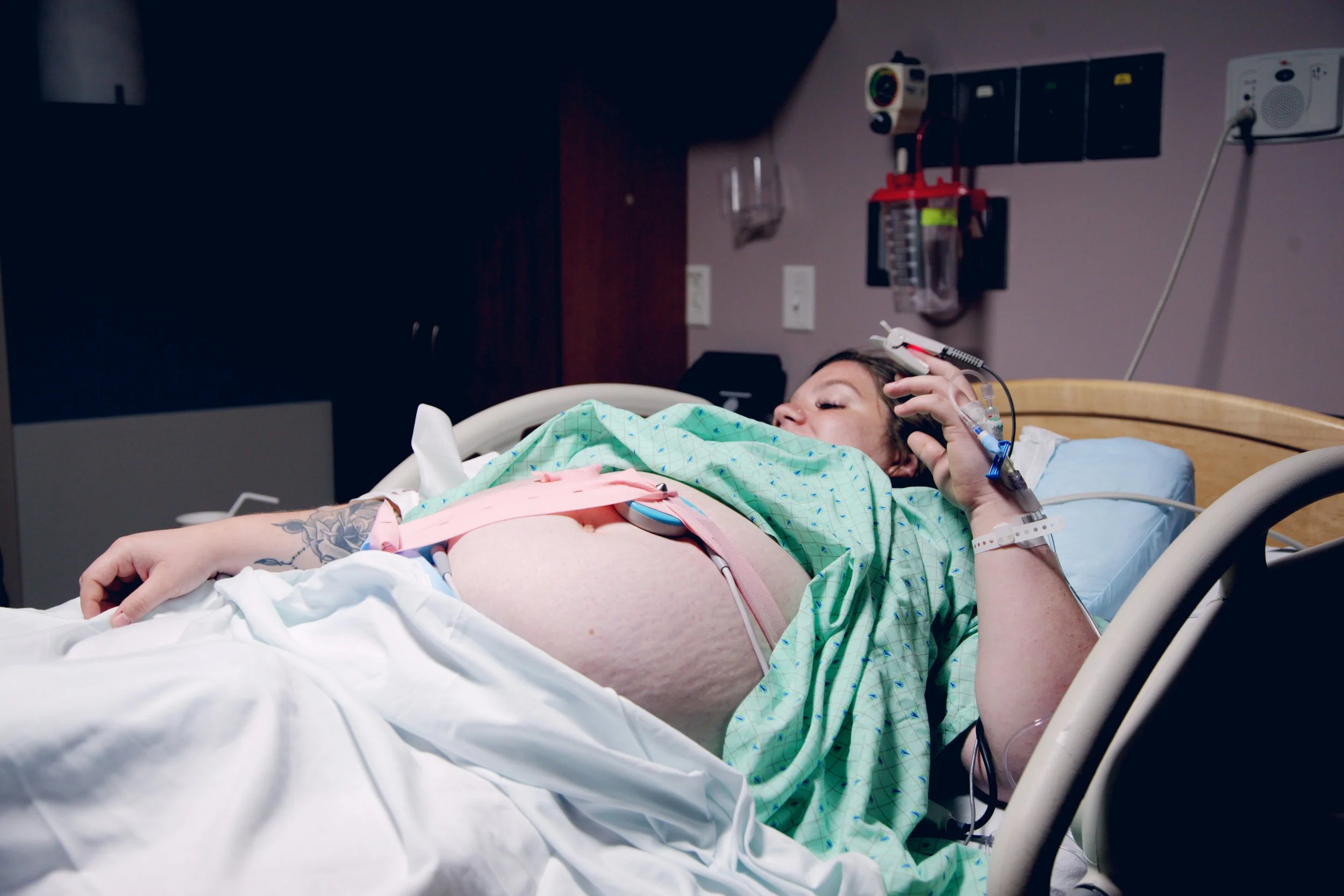
Continuous fetal monitoring uses a disc-shaped monitor (often compared to a hockey puck) that is strapped around the laboring person’s abdomen. Wires connect the monitor to a screen that continuously traces the baby’s heartbeat.
Because babies move, the disc often needs to be repositioned. The straps can feel restrictive, and the monitor can be uncomfortable against a contracting uterus. Most importantly, continuous monitoring significantly limits freedom of movement during labor.
When continuous monitoring was adopted as routine practice for all hospital births — regardless of risk — the hope was that it would reduce neonatal mortality and serious complications.
However, large-scale research has shown that this did not occur.*
Instead, continuous monitoring has been associated with:
Higher cesarean rates
No reduction in neonatal mortality
No reduction in cerebral palsy rates
Continuous monitoring does allow providers to remotely observe multiple patients at once, which supports higher patient-to-nurse ratios and addresses legal documentation concerns in hospital settings. These systemic factors, rather than improved outcomes, largely explain its widespread use.
Intermittent Fetal Monitoring at Alma
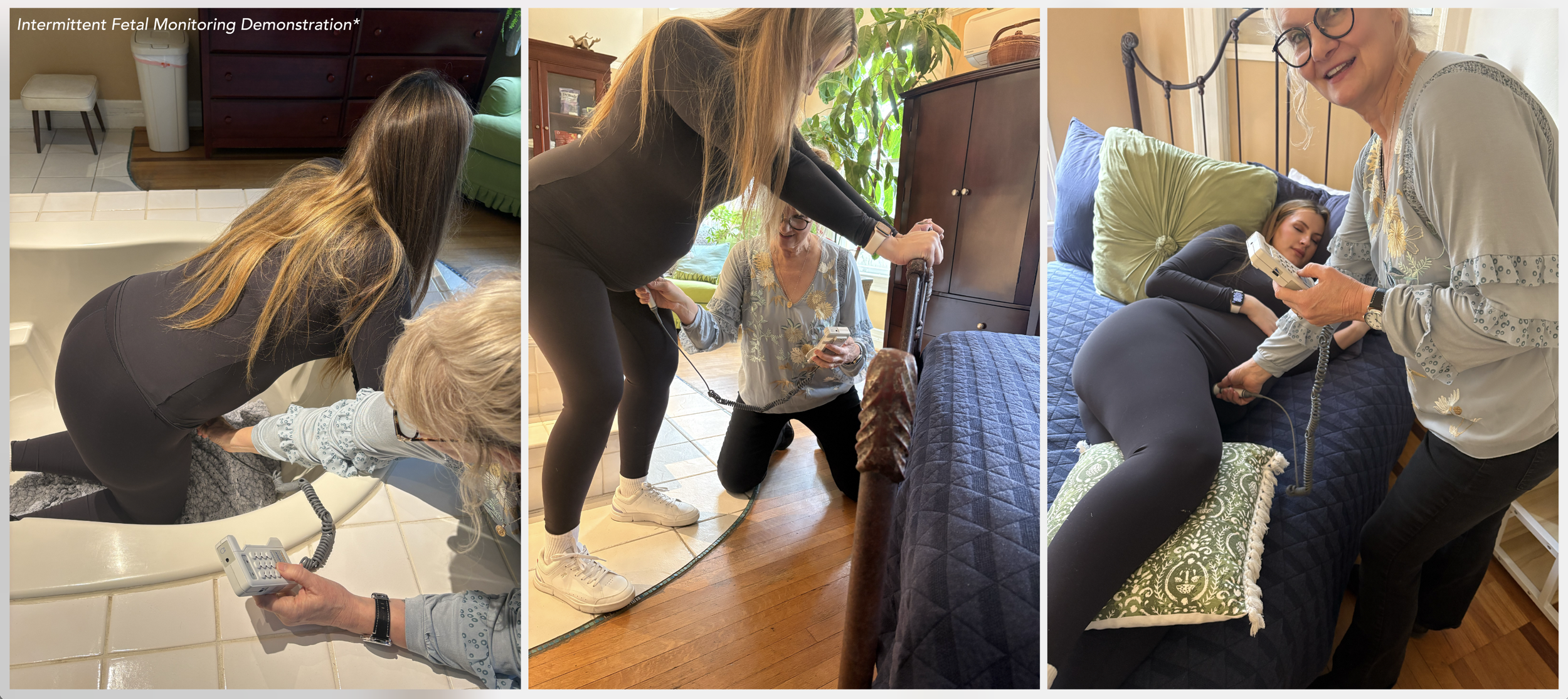
In the community birth setting, intermittent fetal monitoring allows for something essential: freedom of movement.
At Alma, we listen to your baby’s heartbeat at regular intervals — typically every 15–30 minutes during the first stage of labor, and more frequently once pushing begins.
We listen:
Before, during, and after contractions
In any position you prefer
Hands and knees? We tuck the Doppler underneath.
In the birth tub? Not a problem — our Dopplers are waterproof, making water birth a safe and supported option.
Standing and swaying? We sway with you.
This approach supports physiologic birth while still providing attentive, skilled monitoring of your baby’s well-being.
Safety, Skill, and Clinical Judgment
Alma midwives are highly trained to recognize changes or abnormalities in fetal heart patterns.
If we notice concerning “dips” in the heartbeat, we may recommend:
A change in position
IV fluids
Other supportive interventions
A healthy fetal heartbeat reassures the entire birth team that the birth center remains the right place for your baby to be born. If additional support is ever needed, hospital transfers are always an option.
Safety and autonomy are not opposites — they exist together in midwifery care.
Why Families Choose Intermittent Monitoring

Photo By Shanika Granville
Many families are drawn to intermittent fetal monitoring because it supports:
Freedom of movement
Upright and intuitive laboring
Waterbirth options
Fewer unnecessary interventions
For low-risk pregnancies, this approach is supported by decades of research and aligns with how many families want to experience birth.
Interested in Learning More?
If you’re exploring birth options that prioritize movement, autonomy, intermittent fetal monitoring, and water birth, we invite you to connect with us.
Call 503-233-3001 to reserve a spot at our next open house and learn more about care at Alma Midwifery.
About the Author
Laura Erickson, LDEM, CPM
Founder & Midwife, Alma Midwifery
Laura founded Alma Midwifery and has devoted decades to the art and science of midwifery care. She is honored to share the first heartbeat moment with so many families — and says it never gets old.
*Cochrane database review analyzing 13 studies that compared continuous and intermittent fetal monitoring for low risk patients. Researchers found that continuous monitoring was not associated with less perinatal death or lower rates of cerebral palsy compared with intermittent auscultation. Midwives and OBs agree that EFM is most appropriate for monitoring high-risk pregnancies or if there is the use of medications like pitocin to augment labor or epidurals which may affect the fetal heartbeat https://www.nytimes.com/2025/11/06/health/electronic-fetal-monitoring-c-sections.html 11-10-25